

One popular conservation tillage strategy is to leave ample crop residue on fallow land over a growing season, as opposed to fallowing the traditional way (leaving the crop empty to let it collect moisture and restore its nutrients). Traditional fallow techniques often make these fields very susceptible to wind and water erosion. Ample crop residue can both reduce erosion (losses of organic matter), and keep soil nutrients healthy (additions of organic matter). In the second APSIM training module, we compared the organic matter coverage in fallow vs wheat residue cover vs chickpea residue cover.
Because chickpeas have a different Carbon:Nitrogen ratio, we edited this in the SurfaceOrganicMatter nodule of the field tab. Wheat has a C:N of 100, while chickpeas have 25. This means chickpeas will degrade faster, as they have a more ideal balance of nutrients for microbe communities to develop on. In a high C:N ratio, nitrogen becomes the limiting factor.
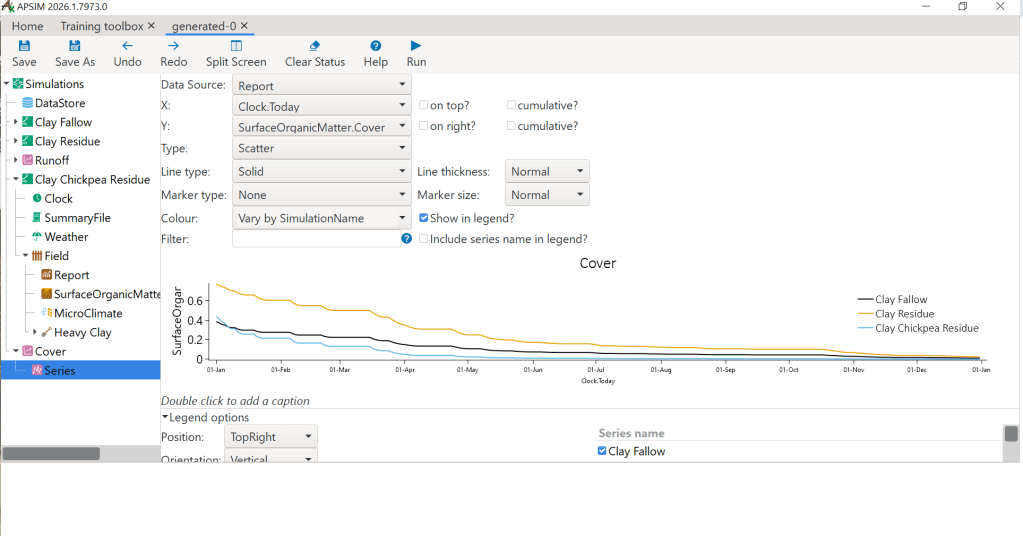
The Clay Fallow simulation still starts with 1000 kg/ha of wheat stubble. I think the APSIM tutorial’s thinking was that this is the standard amount of wehat stubble left after a harvest. The Clay Residue simulation increases this wheat stubble to 3000 kg/ha. The Clay Chickpea Residue simulation starts with the same 3000 kg/ha, but as said before, the C:N ratio is now 4 times lower.
We can see that Chickpeas are not a good source of organic cover residue for a fallow, and we can expect that leaving residue of a crop with a high C:N ratio will ensure that a fallow field is covered for most if not all of the year.
 Jaron Rosso Wiigs